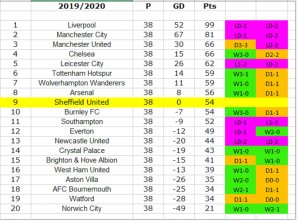
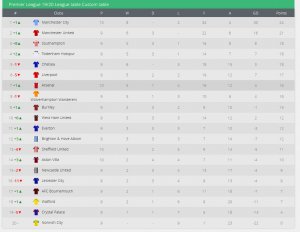
It's quite interesting to look below for any patterns in the final table that might give a bit of insight on our season over all.
It seems to me that the table breaks into 4 blocks. Unsurprisingly we took most points off the bottom teams (30 from the bottom 7) and very few points from the very top teams. However, we did significantly better against the teams just above us than we did against the teams just below us.
Could it be that we have significantly lifted our game when we might realistically be regarded as underdogs, but that we have been too relaxed against teams that are probably similar to us.
In Tufty's 4 years we have built our seasons on being brutally efficient against the lower teams - several quotes referred to us as flat track bullies last year (we didn't lose to anybody below tenth). That carried on this year, but our season was made special by taking 20 points off Chelsea, Spurs, Arsenal, Wolves and Burnley. Did we lift our game - or did they underestimate us, as perhaps we did against Southampton, Everton and Newcastle? Everton is quite interesting - as Everton away seemed like a big game at the time, but we competed all over the pitch and pinched a win. By the time it came round to Everton at home we almost felt superior to them, failed to compete and got beaten.
View attachment 86674
To me I look at that table and there is one very clear and obvious thing that jumps out.
The top 2 teams are miles ahead of anyone else in terms of points accumulated over the season. And I mean, MILES ahead. Why is that? This is probably the most important "trend" from which other teams can try and learn something by looking at that table. Is it about spending big money? Is it about the quality of the players available? Is it about the quality of the manager and the way he sets the team up to play? Maybe it's about all these things? If these were not football clubs, but businesses, (and yes I know they are businesses too), then that would be the very first thing I would want to know.
What is it that the top 2 are doing that the others aren't doing, or not doing as well? Because that, to me, if we can understand it, it the key piece of information for everyone else to learn from. Start by investigating success - always.
At the other end of the table, there's another huge gap, between 19th and 20th place. A gap of 13 points. That is another key observation. If we want to learn "how not to do it" then those numbers suggest there is some learning points to be gained from that.
What is it that Norwich City did, or didn't do, that resulted in them being so far behind everybody else, including the other relegated teams?
Outside of the top 2 you've got what may be considered to be "The Top 6 contenders club", teams that finished between 3rd and 10th, all of which were within easy touching distance of a top 6 finish, which of course usually means a chance of European football. And then you've got the "relegation contenders club", which is any team from 13th place downwards.
Based on this and last season's final Premier League tables, 40 points is probably enough to be confident of survival. But we shouldn't be thinking about that either, that's just something to be aware of and have at the back of our minds. What we should be looking to do is to, if we want to improve, is to better understand what is driving the success of the top 2 teams, and try and emulate that to the best of our ability, (it may not be possible in some areas, but in others it maybe), and avoid at all costs, whatever it was that Norwich City did.
If you want my take on it, I'd say it's this...
Liverpool and Man City have adopted slightly different approaches to the Premier League. Man City, as we know, have bought up the very best talent in the world, and got a very astute, world-class manager, to shape them into an extremely efficient playing outfit. In particular, their possession play is probably the best of any team in the league. They are very difficult to get the ball off when in possession. Liverpool on the other hand, may not have splashed the cash in such quantity, but what they have got is a very strong defensive spine to the team, and lightning quick forwards. They don't hesitate to go direct when they need to. The "long ball" is not a dirty tactic to them, it's a key tactic to release rapid runners, like Mane, Salah, Firmino. Those guys are also clinical finishers, with 55 goals between them this season.
If Sheffield United wanted to try and close the gap on these top 2 - then they'd have to decide whether to go for a Man City type approach, and mop up some expensive world talent to let Wilder mould them into a high possession team, or whether they'd take more of a Liverpool approach and introduce more pace and clinical finishing to the current squad? To me, the first option isn't an option, because we don't have the finances to do it, but we do have the possibility of introducing faster, more clinical players into the team - and that's what I'm hoping will happen to our club this summer. To me, it's probably the most important thing we can do to improve the side.
And the lesson to be learned from Norwich City's plight this season, is if you don't strengthen then you don't survive - simple as that.