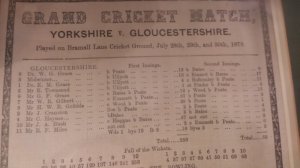
George Ulyett is buried in Burngreave cemetery. He was popularly known as "Happy Jack", once musing memorably that Yorkshire only played him only for his good behaviour and his whistling. As well as neing a very talented cricketer for Yorkshire, he was also a fine all round sportsman and played in the 1882-83 and 1883-84 seasons for our porky cousins.
He made his Yorkshire debut, at the Lane
against Sussex in 1873, and remained a valued member of the team for the next twenty years, passing 1,000 runs in ten seasons and fifty wickets in three. He took his career-best figures of seven for thirty against Surrey in 1878 and, in 1887, made his highest score, 199 not out against Derbyshire. Ulyett also played in the first-ever Test match, staged at the MCG, during that tour, and in 1881/82, Ulyett made his only Test century, hitting 149 at Melbourne in a drawn match. Ulyett played 25 Tests in total.
He was remembered for one of the most famous caughts-and-bowled ever taken in a match versus the Aussies. Ulyett sent down a straight half-volley to Bonnor, who gave it a mighty whack. The ball flew back towards Ulyett with a resounding crack. He had no time to judge it but held out the right hand instinctively, and the leather stuck, right in the middle of his palm. With the sound of Bonnor’s stroke still echoing about the ground, many eyes in the gallery were looking for the area near the boundary where they thought that the ball would land. When, finally, his and other eyes were diverted back towards the pitch, they noticed Ulyett celebrating and Bonnor was departing. It soon dawned on them that Ulyett had taken the catch. Although Ulyett felt no pain in the centre of his hand, there was definitely a fair amount of it on the outside. Bonnor looked at him disgustedly, thinking it almost immoral to have done such a thing, and he walked off gloomily. WG Grace and Lord Harris both told Ulyett that he was foolish to have attempted to take the catch: had it hit his wrist or arm instead, that bone would surely have snapped. Many believed that this was one of the finest catches that they had ever seen.
He played on for Yorkshire for a few more years, but bowled increasingly little and did not take a wicket after 1891. The last of his 18 hundreds came against Middlesex in 1892, and he made a quiet farewell from the first-class game scoring just nine at Bramall Lane in August 1893. After retirement, his health began to fail and five years later he died in Pitsmoor on 18th June 1898, aged just 46, of pneumonia contracted while attending a Yorkshire match. Over 4,000 turned up to his funeral.