
HeySethUTB
Active Member
- Joined
- Jan 1, 2017
- Messages
- 2,216
- Reaction score
- 4,739
So many questions have been raised about the new SCR rules and this summers transfer window. How the hell have some clubs spent ridiculous amounts of money on players, how are some clubs not going to get points deductions and from my own perspective are we skint or not, because I’m confused with the mix of narratives so far this window.
Below is an predictive and experimental view of EFL Championship clubs current situations finances, hopefully with a pinch of salt it provides some sort of realistic explanation to what has been a restricted window for some and a “let’s get the dosh out” for others.
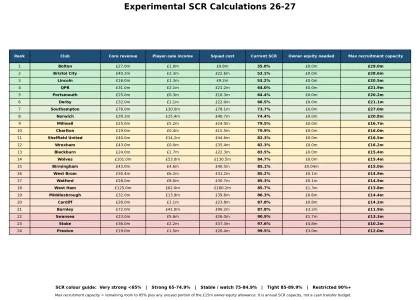
First off SCR figures can flatter clubs whose finances contain net profit from non-recurring transfer income. Among the 14 clubs currently below 85%, six would rise above 85% if player-sale income disappeared:
Clubs like Wrexham, Charlton, Derby, Portsmouth, QPR, Lincoln, Bristol City and Bolton remain below 85% on core revenue alone. Their positions therefore appear structurally more resilient, a combination of large commercial revenue, low squad cost and low/lack of amortisation fees contribute to this for some of the above.
The clubs in red have two related problems.
The severity differs. Watford, West Brom and Birmingham have very small immediate breaches. Preston and Stoke are already operating close to 100%, while Burnley, Middlesbrough and West Ham look especially dependent on major transfer receipts.
When looking at the last column, recruitment capacity, caution needs to be applied. If we take our clubs £16.5m, that only exists with a mixture of £1.5 million in SCR capacity (85%) and an assumed £15 million float from the owners. In reality if our owners don’t commit any additional money, our remaining budget/headroom to comply is £1.5 million.
The new SCR rules essentially benefit clubs that can maximise core revenue and have an ownership that’s willing to top up the clubs finances with £11 million a year on average.
IMO, the sale of Brooks or Hamer was needed, for brooks it was purely an exercise in making money in order to try and comply, it’s why it happened so quickly and out of the blue. With Hamer it wasn’t actually a financial necessity, it was a cash in opportunity. The ownership could have provided a float that covered SCR compliance but the only players in would have been further very restricted frees and loans. It’s safe to say a sale needed to be made. With the additional sale of Hamer and potentially an agreed float in place from the ownership it’s changed the dynamics for Chris again.
Below is an predictive and experimental view of EFL Championship clubs current situations finances, hopefully with a pinch of salt it provides some sort of realistic explanation to what has been a restricted window for some and a “let’s get the dosh out” for others.
First off SCR figures can flatter clubs whose finances contain net profit from non-recurring transfer income. Among the 14 clubs currently below 85%, six would rise above 85% if player-sale income disappeared:
- Wolves - 129%
- Blackburn - 92%
- Sheffield United - 111%
- Millwall - 96%
- Norwich - 104%
- Southampton - 102%
Clubs like Wrexham, Charlton, Derby, Portsmouth, QPR, Lincoln, Bristol City and Bolton remain below 85% on core revenue alone. Their positions therefore appear structurally more resilient, a combination of large commercial revenue, low squad cost and low/lack of amortisation fees contribute to this for some of the above.
The clubs in red have two related problems.
Their present squad costs exceed 85% of adjusted income.
And, Every one of them would remain above 85% without player-sale income or ownership cash injection.
The severity differs. Watford, West Brom and Birmingham have very small immediate breaches. Preston and Stoke are already operating close to 100%, while Burnley, Middlesbrough and West Ham look especially dependent on major transfer receipts.
When looking at the last column, recruitment capacity, caution needs to be applied. If we take our clubs £16.5m, that only exists with a mixture of £1.5 million in SCR capacity (85%) and an assumed £15 million float from the owners. In reality if our owners don’t commit any additional money, our remaining budget/headroom to comply is £1.5 million.
The new SCR rules essentially benefit clubs that can maximise core revenue and have an ownership that’s willing to top up the clubs finances with £11 million a year on average.
IMO, the sale of Brooks or Hamer was needed, for brooks it was purely an exercise in making money in order to try and comply, it’s why it happened so quickly and out of the blue. With Hamer it wasn’t actually a financial necessity, it was a cash in opportunity. The ownership could have provided a float that covered SCR compliance but the only players in would have been further very restricted frees and loans. It’s safe to say a sale needed to be made. With the additional sale of Hamer and potentially an agreed float in place from the ownership it’s changed the dynamics for Chris again.


 hopefully we can have a thread like this running continuosly to keep our own little eye on things.


