
An experimental look at Championship finances

All advertisments are hidden for logged in members, why not log in/register?

HeySethUTB

Active Member
Joined
Jan 1, 2017
Messages
2,120
Reaction score
4,571
So many questions have been raised about the new SCR rules and this summers transfer window. How the hell have some clubs spent ridiculous amounts of money on players, how are some clubs not going to get points deductions and from my own perspective are we skint or not, because I’m confused with the mix of narratives so far this window.

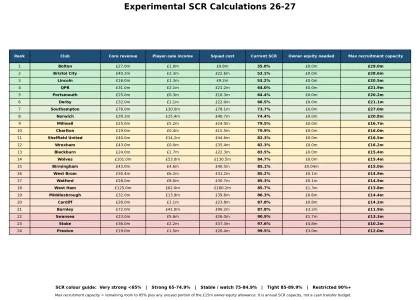
Below is an predictive and experimental view of EFL Championship clubs current situations finances, hopefully with a pinch of salt it provides some sort of realistic explanation to what has been a restricted window for some and a “let’s get the dosh out” for others.
Experimental_SCR_Calculations_26_27_clean_title 2.webp

First off SCR figures can flatter clubs whose finances contain net profit from non-recurring transfer income. Among the 14 clubs currently below 85%, six would rise above 85% if player-sale income disappeared:
  • Wolves - 129%
  • Blackburn - 92%
  • Sheffield United - 111%
  • Millwall - 96%
  • Norwich - 104%
  • Southampton - 102%
It’s safe to assume that the clubs above will join a list of clubs that have to rely heavily on a mix of player sales, ownership cash float (max £15 million injection a season, £33 million over 3 years) and natural contract wastage in order to comply with SCR next season if promotion is not achieved in this current campaign. This would change if anymore substantial outgoings happen this season for the clubs listed. To stop any confusion it’s important to remember transfers fees are paid in instalments so Millwall are still benefiting from our payments for Tanganga and Burnley’s payments for Zain Fleming.

Clubs like Wrexham, Charlton, Derby, Portsmouth, QPR, Lincoln, Bristol City and Bolton remain below 85% on core revenue alone. Their positions therefore appear structurally more resilient, a combination of large commercial revenue, low squad cost and low/lack of amortisation fees contribute to this for some of the above.

The clubs in red have two related problems.

Their present squad costs exceed 85% of adjusted income.​
And, Every one of them would remain above 85% without player-sale income or ownership cash injection.​

The severity differs. Watford, West Brom and Birmingham have very small immediate breaches. Preston and Stoke are already operating close to 100%, while Burnley, Middlesbrough and West Ham look especially dependent on major transfer receipts.

When looking at the last column, recruitment capacity, caution needs to be applied. If we take our clubs £16.5m, that only exists with a mixture of £1.5 million in SCR capacity (85%) and an assumed £15 million float from the owners. In reality if our owners don’t commit any additional money, our remaining budget/headroom to comply is £1.5 million.

The new SCR rules essentially benefit clubs that can maximise core revenue and have an ownership that’s willing to top up the clubs finances with £11 million a year on average.

IMO, the sale of Brooks or Hamer was needed, for brooks it was purely an exercise in making money in order to try and comply, it’s why it happened so quickly and out of the blue. With Hamer it wasn’t actually a financial necessity, it was a cash in opportunity. The ownership could have provided a float that covered SCR compliance but the only players in would have been further very restricted frees and loans. It’s safe to say a sale needed to be made. With the additional sale of Hamer and potentially an agreed float in place from the ownership it’s changed the dynamics for Chris again.


Very interesting. But if you breach it the penalties are soft to start arent they? Is it right rhat points off is for something like 115% in which case why not risk it?
 
I am going to say good work but I am thick and don't quite understand it. So if you could explain these things please -
1. where did you get Core revenue from?
2. what is included in squad cost and where did you get this from?
3. How did you calculate recruitment capacity?
4. Won't a player sale or purchase immediately change everything?
5. What will be the effect of a loan signing?
6. If you have a poor season or a good season won't it effect revenue?
7. Won't a good cup run affect revenue?
Thanks
 
Love owt like this me.

Suggests £10m for Souttar is a pipe dream then?

In short no. Not really. Predictively we may only have about £1.5m of organic headroom, but a £10m transfer fee would normally be amortised across the length of a player’s contract.

We wouldn’t be expected to or even attempt to pay £10 million up front, for example offering him a four year contract works out at £2.5m a year and a three-year contract £3.3m a year, plus Souttar’s wages, bonuses and relevant agent costs.

IMO, any deal probably wouldn’t be comfortably supported by existing income alone. But instead would depend on the owners funding the extra couple of million this year via an ownership top up, which is allowed in the rules and therefore doesn’t affect our SCR percentage.
 
Very interesting. But if you breach it the penalties are soft to start arent they? Is it right rhat points off is for something like 115% in which case why not risk it?

My understanding is the 115% threshold and automatic six-point deduction belong to the Premier League’s version of SCR. Under that system 85%–115% a financial levy is introduced and above 115% is a six point deduction plus another point per £6.5m overspent.

The Championship framework is different where 85% is the agreed relevant spending limit, after permitted owner-equity support. Exceeding it triggers EFL intervention and referral to the Club Financial Review Panel.

That panel will then consider the amount and seriousness of the breach and whether it was deliberate, reckless or negligent. The possible consequences are vague which does worry me, but include anything from a controlled budget, transfer/registration restrictions, fines or a points deduction.

So yes, clubs could technically choose to gamble, but any club doing that would have no idea what the price is, beforehand.
 
My understanding is the 115% threshold and automatic six-point deduction belong to the Premier League’s version of SCR. Under that system 85%–115% a financial levy is introduced and above 115% is a six point deduction plus another point per £6.5m overspent.

The Championship framework is different where 85% is the agreed relevant spending limit, after permitted owner-equity support. Exceeding it triggers EFL intervention and referral to the Club Financial Review Panel.

That panel will then consider the amount and seriousness of the breach and whether it was deliberate, reckless or negligent. The possible consequences are vague which does worry me, but include anything from a controlled budget, transfer/registration restrictions, fines or a points deduction.

So yes, clubs could technically choose to gamble, but any club doing that would have no idea what the price is, beforehand.
Isn't it 85% before permitted owner support?
 
I always thought scr was calculated over a three year period, is that not right?

SCR is aiming to be “real time” whatever that means, so the EFL is assessing SCR season by season, with monitoring during the year and confirmation using the final annual figures.

It’s not intended to average the SCR itself over a rolling three-year period. The rolling three-year element applies only to the permitted owner-equity allowance of £33 million over that time frame with a maximum of £15 million a season, while transfer amortisation can carry costs across several annual SCR calculations.

The three-year rolling loss test belonged to the old P&S/PSR system that SCR replaces.
 
So many questions have been raised about the new SCR rules and this summers transfer window. How the hell have some clubs spent ridiculous amounts of money on players, how are some clubs not going to get points deductions and from my own perspective are we skint or not, because I’m confused with the mix of narratives so far this window.

Below is an predictive and experimental view of EFL Championship clubs current situations finances, hopefully with a pinch of salt it provides some sort of realistic explanation to what has been a restricted window for some and a “let’s get the dosh out” for others.

View attachment 241891

First off SCR figures can flatter clubs whose finances contain net profit from non-recurring transfer income. Among the 14 clubs currently below 85%, six would rise above 85% if player-sale income disappeared:
  • Wolves - 129%
  • Blackburn - 92%
  • Sheffield United - 111%
  • Millwall - 96%
  • Norwich - 104%
  • Southampton - 102%
It’s safe to assume that the clubs above will join a list of clubs that have to rely heavily on a mix of player sales, ownership cash float (max £15 million injection a season, £33 million over 3 years) and natural contract wastage in order to comply with SCR next season if promotion is not achieved in this current campaign. This would change if anymore substantial outgoings happen this season for the clubs listed. To stop any confusion it’s important to remember transfers fees are paid in instalments so Millwall are still benefiting from our payments for Tanganga and Burnley’s payments for Zain Fleming.

Clubs like Wrexham, Charlton, Derby, Portsmouth, QPR, Lincoln, Bristol City and Bolton remain below 85% on core revenue alone. Their positions therefore appear structurally more resilient, a combination of large commercial revenue, low squad cost and low/lack of amortisation fees contribute to this for some of the above.

The clubs in red have two related problems.

Their present squad costs exceed 85% of adjusted income.​
And, Every one of them would remain above 85% without player-sale income or ownership cash injection.​

The severity differs. Watford, West Brom and Birmingham have very small immediate breaches. Preston and Stoke are already operating close to 100%, while Burnley, Middlesbrough and West Ham look especially dependent on major transfer receipts.

When looking at the last column, recruitment capacity, caution needs to be applied. If we take our clubs £16.5m, that only exists with a mixture of £1.5 million in SCR capacity (85%) and an assumed £15 million float from the owners. In reality if our owners don’t commit any additional money, our remaining budget/headroom to comply is £1.5 million.

The new SCR rules essentially benefit clubs that can maximise core revenue and have an ownership that’s willing to top up the clubs finances with £11 million a year on average.

IMO, the sale of Brooks or Hamer was needed, for brooks it was purely an exercise in making money in order to try and comply, it’s why it happened so quickly and out of the blue. With Hamer it wasn’t actually a financial necessity, it was a cash in opportunity. The ownership could have provided a float that covered SCR compliance but the only players in would have been further very restricted frees and loans. It’s safe to say a sale needed to be made. With the additional sale of Hamer and potentially an agreed float in place from the ownership it’s changed the dynamics for Chris again.
Outstanding post love this type of stuff especially as a NBA Cap space nerd. 😍 hopefully we can have a thread like this running continuosly to keep our own little eye on things.
 
Isn't it 85% before permitted owner support?
Spot on. If you take Stoke as an example from the data, at 97% current. The owner needs to inject £4.8 million or they need raise this via player sales, so they remain compliant this coming season. No sales and it eats into the allowed £33 million owner top up, over the next three years
 
Last edited:
Outstanding post love this type of stuff especially as a NBA Cap space nerd. 😍 hopefully we can have a thread like this running continuosly to keep our own little eye on things.

I’ll try to keep an eye on things transfer wise and update accordingly at the end of the window. I’m fairly confident it gives us footballing nerds a rough picture, what will certainly help the data is when the newest accounts drop.
 
Spot on. If you take Stoke as an example from the data, at 97% current. The owner needs to inject £4.8 million or they need raise this via player sales, so they remain compliant this coming season. Eating into their £33 million over the next three years
Fantastic thread you've started with real insight. You could be the new Kieran Maguire or an actuary by profession. Cheers for this.
 
My understanding is the 115% threshold and automatic six-point deduction belong to the Premier League’s version of SCR. Under that system 85%–115% a financial levy is introduced and above 115% is a six point deduction plus another point per £6.5m overspent.

The Championship framework is different where 85% is the agreed relevant spending limit, after permitted owner-equity support. Exceeding it triggers EFL intervention and referral to the Club Financial Review Panel.

That panel will then consider the amount and seriousness of the breach and whether it was deliberate, reckless or negligent. The possible consequences are vague which does worry me, but include anything from a controlled budget, transfer/registration restrictions, fines or a points deduction.

So yes, clubs could technically choose to gamble, but any club doing that would have no idea what the price is, beforehand.
Exactly this by the way fantastic work HeySeth ,I would have thought that this would have been the ideal opportunity to put hard and fast rules in place so that all clubs are treated equally


Do academy outgoings still count as pure profit compared to other outgoings?

My simplistic understanding is that the sustainability of clubs has been boosted by the 85% limit and the owners being limited to equity gifts for a maximum of 33 million over three years rather than saddling the clubs with up to 39 million of debt every three years

Football is still essentially batshit as the 33 million is a reduction on the past 39 million albeit it's added to 85%, which could be even more egregious in the past if added to 85% +. The players and agents still have the clubs over a barrel as they'll inevitably go to 85% plus 11 million per season
 
Last edited:
Spot on. If you take Stoke as an example from the data, at 97% current. The owner needs to inject £4.8 million or they need raise this via player sales, so they remain compliant this coming season. No sales and it eats into the allowed £33 million owner top up, over the next three years
Haven't stoke been spunking money too? I have a feeling bet365 pay them quite a lot
 
Surely under these new rules - Leicester City - in League 1 must be completely stuffed and in big trouble. Their wage bill must still be huge. But maybe they don’t care & are just going to try & blitz League 1 and absorb any 6 pt deduction?
 
Looks interesting, but it's good practice when sharing data to include the source(s), because without explaining how you arrived at the figures they're essentially worthless.
 
Looks interesting, but it's good practice when sharing data to include the source(s), because without explaining how you arrived at the figures they're essentially worthless.

I’m unsure if you’re challenging the mathematics or the provenance and evidential basis of the inputs required to perform that mathematics, without working for the EFL or club I cannot claim to have access to official datasets or a claim to know the figures in clubs’ confidential submissions. However, in order justify what I’ve already stated is both experimental and predictive, I’m more than happy to explain the methodology for both.

It’s fair criticism, of how the tables narrative was presented, although “worthless” is a very dismissive tone.

So the maths, its simple really, and is constructed from three estimated inputs, core revenue, player-sale income and squad cost.

The methodology is reproducible: Estimated SCR = squad cost ÷ (core revenue + player-sale income).

This model then measures the club against the 85% limit and adds the unused portion of the assumed £15m annual owner-equity allowance to calculate maximum annual recruitment capacity. That is SCR capacity, not a transfer-fee budget. For Sheffield United, for example:

Estimates - £40.0m core revenue + £14.2m player-sale income = £54.2m.

£44.6m squad cost ÷ £54.2m = 82.3%.

An 85% ceiling would permit approximately £46.1m, leaving roughly £1.5m of ordinary headroom. Adding the £15m equity assumption produces the £16.5m figure in the table. I wouldn’t then make the statement that the outputs are arbitrary, or worthless, but each to their own.

When looking at the provenance of these figures the “Core revenue” I’ve listed is not a figure clubs report under that exact heading. It was estimated from the latest available statutory accounts, starting with operating turnover and excluding player-sale income. Adjustments were then made for the projected 2026/27 circumstances of each club, including divisional status, parachute or central distributions and material changes in commercial, broadcasting and matchday income.

The “Estimated squad cost” is also not simply the total staff-cost figure in the accounts. It was projected from the latest available wage and player-cost disclosures, adjusted where possible for promotion or relegation, known squad changes and player-related costs. Public accounts are historic and do not disclose every contract, bonus, agent payment or transfer instalment, so sensible rather than selective assumptions and estimates were unavoidable.

When newer accounts become available, the starting figures can be replaced and the projections refined. I suppose for now it’s easier to say that the model’s mathematical outputs are exact relative to its inputs, but its predictive accuracy depends entirely on the accuracy of those inputs. Until it is back-tested (latest accounts) it should be treated as an experimental and predictive financial-pressure model rather than a precise forecast of official SCR positions, only the EFL would have the resources and access to do that. Hope this adds some sort of credence for you.
 
Last edited:
Interested to know where the £40m in revenue has come from?

The last 2 ‘true’ Championship seasons we had, where we didn’t have the benefit of parachute payments were 17/18 and 18/19. The turnover in those 2 years was £20m and £20.8m respectively.

If you take an average on ticket sales of 25k per week @ £30 per ticket x 23 games it’s £17.25m.

Then we have commercial and TV income, the latter expected to be around £4m-£5m. Commercial revenue, I’m not sure but it’s not going to be anything above £3m-£5m.

I’d say £30m is a top end estimate for our revenue for next season, players sales excluded, obviously.
 

All advertisments are hidden for logged in members, why not log in/register?

All advertisments are hidden for logged in members, why not log in/register?

Back
Top Bottom