
Bergen Blade
Well-Known Member
Had a look at the Shrewsbury match on BP. There will be always players who have off days occasionally, but what we should aim for is that we get the organisation of the team right. Often poor player performances can be due to things that aren’t working tactically.
Two things that we should look to adjust:
1 Distance between defence and midfield. Defenders don’t like strikers getting in behind them. To prevent this they often drop down deeper to minimise the space behind them. What can happen then is that space can open up in front of them, and our midfielders get too much room to cover.
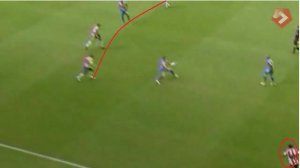
Shrewsbury took advantage of this, often they would hit it long to one of their strikers who met the ball, flicked it, or played it back to a midfield runner who could then advance on the ball with forward facing teammates available. Despite us not having wingers across midfield (normally means more solidity) our midfielders couldn’t manage. Photo below shows the gap between our backline and midfield and Shrewsbury taking advantage.
SOLUTIONS: More aggression and intesity from the back four. They need to push up when they can. Another solution is to play Monty and Doyle to chase, or even change the formation to 4-5-1, but I don’t think we want to go there.
2 Quick strikers not able to use pace. It’s a long time since we had so much pace up front, and Blackman and Cofie have some great individual attributes. So why couldn’t they get in behind the Shrewsbury defence?
I think the primary problem is that we became too one dimensional in our attack. With two so quick strikers we really wanted to play through balls for them to run onto. Which made us forget how to get attacks going in the first two thirds of the pitch. Shrewsbury’s excellent closing down high up the pitch should be mentioned here. But we lacked urgency, movement and tempo, failed to get any sort of rhythm into our build up play, continually being forced to pass it
When the predictable long ball came, the big Shrewsbury defenders was able to drop off and attack the ball, winning almost every challenge against Blackman and Cofie. They were very rarely facing the opposition goal when they received the ball. Our build up was also so slow and random that it made it difficult for them to know when to initiate runs.
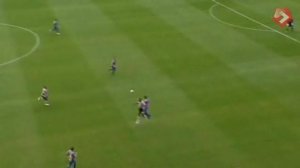
SOLUTIONS: If you can’t find/exploit space in behind defences, the next best thing is the space between the opposition defence and midfield – and wide. Better tempo, more urgency, more movement, having someone in the midfield positions who can advance on the ball with pace, someone with the ability to dribble. Alternatively, play a back to goal target man who can win high balls and hold it up in front of their defensive line. 4-4-1-1 is another option, as is moving one of the strikers to a wide position, to see if his pace can be better used from deeper.
Two things that we should look to adjust:
1 Distance between defence and midfield. Defenders don’t like strikers getting in behind them. To prevent this they often drop down deeper to minimise the space behind them. What can happen then is that space can open up in front of them, and our midfielders get too much room to cover.
Shrewsbury took advantage of this, often they would hit it long to one of their strikers who met the ball, flicked it, or played it back to a midfield runner who could then advance on the ball with forward facing teammates available. Despite us not having wingers across midfield (normally means more solidity) our midfielders couldn’t manage. Photo below shows the gap between our backline and midfield and Shrewsbury taking advantage.
SOLUTIONS: More aggression and intesity from the back four. They need to push up when they can. Another solution is to play Monty and Doyle to chase, or even change the formation to 4-5-1, but I don’t think we want to go there.
2 Quick strikers not able to use pace. It’s a long time since we had so much pace up front, and Blackman and Cofie have some great individual attributes. So why couldn’t they get in behind the Shrewsbury defence?
I think the primary problem is that we became too one dimensional in our attack. With two so quick strikers we really wanted to play through balls for them to run onto. Which made us forget how to get attacks going in the first two thirds of the pitch. Shrewsbury’s excellent closing down high up the pitch should be mentioned here. But we lacked urgency, movement and tempo, failed to get any sort of rhythm into our build up play, continually being forced to pass it
a backwards
b to a marked teammate facing his own goal
c ultimately – long
When the predictable long ball came, the big Shrewsbury defenders was able to drop off and attack the ball, winning almost every challenge against Blackman and Cofie. They were very rarely facing the opposition goal when they received the ball. Our build up was also so slow and random that it made it difficult for them to know when to initiate runs.
SOLUTIONS: If you can’t find/exploit space in behind defences, the next best thing is the space between the opposition defence and midfield – and wide. Better tempo, more urgency, more movement, having someone in the midfield positions who can advance on the ball with pace, someone with the ability to dribble. Alternatively, play a back to goal target man who can win high balls and hold it up in front of their defensive line. 4-4-1-1 is another option, as is moving one of the strikers to a wide position, to see if his pace can be better used from deeper.


 , but overall it makes sense;