
Wilder's tactics so far

All advertisments are hidden for logged in members, why not log in/register?

Bergen Blade

Well-Known Member
Joined
Aug 7, 2009
Messages
7,383
Reaction score
19,466
Location
Bergen, Norway
By all accounts, Chris Wilder's preferred formation at Northampton was 4-2-3-1. After joining the Blades he stated that he had a preferred system, although he didn't actually say which one. But he did reveal he would be signing players to fit the system, not vice versa. After the Blades seemed to play most pre season games with a 4-2-3-1 system most Blades assumed that would be Wilder's preference.

In the final pre season game vs Derby we lined up like this:
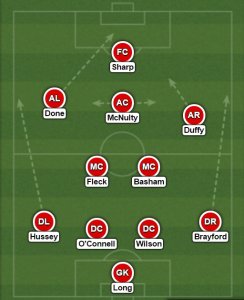
Line Up 2016-17.jpg

On paper, and to some extent in the pre season matches, it looked exciting. The three players behind Sharp had been roaming, swapping positions and playing fast, exciting football and all looked like goal threats. A wingless formation, the width was supposed to come from the full backs, which Wilder suggested would be the best in the division. Fleck was the new playmaker, backed up by the work rate of Basham. In Adkins' teams only the two strikers looked like goal threats, but in the above team goals looked like they could come from all over. Done, McNulty, Duffy


But then we signed Leon Clarke. After originally looking for a target man type striker as a plan B, a cheap (?) squad player likely to be used from the bench, Wilder suddenly found himself having signed one of the top scorers from last season. With Billy Sharp (21 goals last season) and Clarke (18) it became too tempting not to use them both. Clarke gave the team some added height and strength, which the above team admittedly lacked.

But so far it hasn't worked. At Bolton I think Wilder still would call his formation 4-2-3-1, with Clarke in a bit withdrawn role behind Sharp. But with Clarke included it becomes natural, or tempting, to make use of his target man qualities. Goal kicks and free kicks from our half were aimed at him, as was the odd long ball. For throw ins he came to flick it on. For crosses he had to be in the box. His role became very similar to that of an orthodox target man and vs Rochdale our formation looked very much like a narrow 4-4-2.


I was concerned of how this would tweak player roles. There was little of the clever link up play that had been seen by the likes of McNulty and Scougall in pre season. Vs Derby McNulty also worked hard defensively, helping out the often outnumbered Fleck and Basham centrally, but also tracking back to cover for Done and Duffy on occasions.

With Clarke and Sharp now playing effectively up front together, Done and Duffy have been forced to drop deeper and work harder defensively. This has reduced their attacking impact. Duffy hasn't had enough skilful teammates to interplay with and when Done has got into the box he hasn't been able to get on the end of things.


With two experienced *star* strikers up front I think it has become too tempting for the other players to look for them too early, too often. Vs Rochdale this saw us play a lot of long balls, rather than trying to build penetrative attacks with the pace and movement that Wilder's teams are known for. It became too predictable and easy for Rochdale's defence to deal with.


Opposition teams:

The opposition teams deserve some credit for stopping us. Bolton, Crewe and Rochdale have all lined up with 4-5-1 formations and tried to prevent us getting space to play in and run into. We have generally started well, pressing high up the pitch, but after 20-25 minutes the opposition have started to get into the game more. Do we tire? Is the style too physically demanding? Or do we struggle to counteract their counteraction, i.e stuff like this:


Both Bolton and Rochdale seemed to win a lot of throw ins down our left after hitting long balls up to this area. Even though they didn't always win the header, they were able to put us under so much pressure for the second ball that our players often just cleared it out for a throw in. The likes of Done and Fleck aren't the biggest and struggled with the bouncing balls in this area of the pitch. Bolton and Rochdale were able to stop our momentum, slow the game down and give their defence a break. Simple tactics, but effective.

These long balls also made it more difficult for us to press high the way we want to. When we tried, the opposition would often just play it backwards, until another long punt upfield came and this became the pattern of the game. No matter how much Done tried, and ran, he rarely got close enough, followed by having to get to get back to defend again. Frustrating!

Our answer to this was to go longer ourselves, especially vs Rochdale, and so the game became very scrappy. The team isn't quite equipped to play this way and it's not Wilder's style. We don't look happy defending deep. We'd need more solid wide men and more pace up front for a 4-4-2 to work, but maybe it will be easier to return to the formation and set up we practiced in the summer.

Some things for Wilder to consider

  • Drop Sharp or Clarke
  • Find a number 10 that contributes offensively and defensively
  • Find a more constructive midfield option than Basham
  • Get that pacey forward signed
  • Stick to your principles
  • Certainly return to them if new things don't work


By all accounts, Chris Wilder's preferred formation at Northampton was 4-2-3-1. After joining the Blades he stated that he had a preferred system, although he didn't actually say which one. But he did reveal he would be signing players to fit the system, not vice versa. After the Blades seemed to play most pre season games with a 4-2-3-1 system most Blades assumed that would be Wilder's preference.

In the final pre season game vs Derby we lined up like this:

View attachment 19099

On paper, and to some extent in the pre season matches, it looked exciting. The three players behind Sharp had been roaming, swapping positions and playing fast, exciting football and all looked like goal threats. A wingless formation, the width was supposed to come from the full backs, which Wilder suggested would be the best in the division. Fleck was the new playmaker, backed up by the work rate of Basham. In Adkins' teams only the two strikers looked like goal threats, but in the above team goals looked like they could come from all over. Done, McNulty, Duffy


But then we signed Leon Clarke. After originally looking for a target man type striker as a plan B, a cheap (?) squad player likely to be used from the bench, Wilder suddenly found himself having signed one of the top scorers from last season. With Billy Sharp (21 goals last season) and Clarke (18) it became too tempting not to use them both. Clarke gave the team some added height and strength, which the above team admittedly lacked.

But so far it hasn't worked. At Bolton I think Wilder still would call his formation 4-2-3-1, with Clarke in a bit withdrawn role behind Sharp. But with Clarke included it becomes natural, or tempting, to make use of his target man qualities. Goal kicks and free kicks from our half were aimed at him, as was the odd long ball. For throw ins he came to flick it on. For crosses he had to be in the box. His role became very similar to that of an orthodox target man and vs Rochdale our formation looked very much like a narrow 4-4-2.


I was concerned of how this would tweak player roles. There was little of the clever link up play that had been seen by the likes of McNulty and Scougall in pre season. Vs Derby McNulty also worked hard defensively, helping out the often outnumbered Fleck and Basham centrally, but also tracking back to cover for Done and Duffy on occasions.

With Clarke and Sharp now playing effectively up front together, Done and Duffy have been forced to drop deeper and work harder defensively. This has reduced their attacking impact. Duffy hasn't had enough skilful teammates to interplay with and when Done has got into the box he hasn't been able to get on the end of things.


With two experienced *star* strikers up front I think it has become too tempting for the other players to look for them too early, too often. Vs Rochdale this saw us play a lot of long balls, rather than trying to build penetrative attacks with the pace and movement that Wilder's teams are known for. It became too predictable and easy for Rochdale's defence to deal with.


Opposition teams:

The opposition teams deserve some credit for stopping us. Bolton, Crewe and Rochdale have all lined up with 4-5-1 formations and tried to prevent us getting space to play in and run into. We have generally started well, pressing high up the pitch, but after 20-25 minutes the opposition have started to get into the game more. Do we tire? Is the style too physically demanding? Or do we struggle to counteract their counteraction, i.e stuff like this:


Both Bolton and Rochdale seemed to win a lot of throw ins down our left after hitting long balls up to this area. Even though they didn't always win the header, they were able to put us under so much pressure for the second ball that our players often just cleared it out for a throw in. The likes of Done and Fleck aren't the biggest and struggled with the bouncing balls in this area of the pitch. Bolton and Rochdale were able to stop our momentum, slow the game down and give their defence a break. Simple tactics, but effective.

These long balls also made it more difficult for us to press high the way we want to. When we tried, the opposition would often just play it backwards, until another long punt upfield came and this became the pattern of the game. No matter how much Done tried, and ran, he rarely got close enough, followed by having to get to get back to defend again. Frustrating!

Our answer to this was to go longer ourselves, especially vs Rochdale, and so the game became very scrappy. The team isn't quite equipped to play this way and it's not Wilder's style. We don't look happy defending deep. We'd need more solid wide men and more pace up front for a 4-4-2 to work, but maybe it will be easier to return to the formation and set up we practiced in the summer.

Some things for Wilder to consider

  • Drop Sharp or Clarke
  • Find a number 10 that contributes offensively and defensively
  • Find a more constructive midfield option than Basham
  • Get that pacey forward signed
  • Stick to your principles
  • Certainly return to them if new things don't work

We have two wingers now can we give them the ball and get some crosses in,simple
 
By all accounts, Chris Wilder's preferred formation at Northampton was 4-2-3-1. After joining the Blades he stated that he had a preferred system, although he didn't actually say which one. But he did reveal he would be signing players to fit the system, not vice versa. After the Blades seemed to play most pre season games with a 4-2-3-1 system most Blades assumed that would be Wilder's preference.

In the final pre season game vs Derby we lined up like this:

View attachment 19099

On paper, and to some extent in the pre season matches, it looked exciting. The three players behind Sharp had been roaming, swapping positions and playing fast, exciting football and all looked like goal threats. A wingless formation, the width was supposed to come from the full backs, which Wilder suggested would be the best in the division. Fleck was the new playmaker, backed up by the work rate of Basham. In Adkins' teams only the two strikers looked like goal threats, but in the above team goals looked like they could come from all over. Done, McNulty, Duffy


But then we signed Leon Clarke. After originally looking for a target man type striker as a plan B, a cheap (?) squad player likely to be used from the bench, Wilder suddenly found himself having signed one of the top scorers from last season. With Billy Sharp (21 goals last season) and Clarke (18) it became too tempting not to use them both. Clarke gave the team some added height and strength, which the above team admittedly lacked.

But so far it hasn't worked. At Bolton I think Wilder still would call his formation 4-2-3-1, with Clarke in a bit withdrawn role behind Sharp. But with Clarke included it becomes natural, or tempting, to make use of his target man qualities. Goal kicks and free kicks from our half were aimed at him, as was the odd long ball. For throw ins he came to flick it on. For crosses he had to be in the box. His role became very similar to that of an orthodox target man and vs Rochdale our formation looked very much like a narrow 4-4-2.


I was concerned of how this would tweak player roles. There was little of the clever link up play that had been seen by the likes of McNulty and Scougall in pre season. Vs Derby McNulty also worked hard defensively, helping out the often outnumbered Fleck and Basham centrally, but also tracking back to cover for Done and Duffy on occasions.

With Clarke and Sharp now playing effectively up front together, Done and Duffy have been forced to drop deeper and work harder defensively. This has reduced their attacking impact. Duffy hasn't had enough skilful teammates to interplay with and when Done has got into the box he hasn't been able to get on the end of things.


With two experienced *star* strikers up front I think it has become too tempting for the other players to look for them too early, too often. Vs Rochdale this saw us play a lot of long balls, rather than trying to build penetrative attacks with the pace and movement that Wilder's teams are known for. It became too predictable and easy for Rochdale's defence to deal with.


Opposition teams:

The opposition teams deserve some credit for stopping us. Bolton, Crewe and Rochdale have all lined up with 4-5-1 formations and tried to prevent us getting space to play in and run into. We have generally started well, pressing high up the pitch, but after 20-25 minutes the opposition have started to get into the game more. Do we tire? Is the style too physically demanding? Or do we struggle to counteract their counteraction, i.e stuff like this:


Both Bolton and Rochdale seemed to win a lot of throw ins down our left after hitting long balls up to this area. Even though they didn't always win the header, they were able to put us under so much pressure for the second ball that our players often just cleared it out for a throw in. The likes of Done and Fleck aren't the biggest and struggled with the bouncing balls in this area of the pitch. Bolton and Rochdale were able to stop our momentum, slow the game down and give their defence a break. Simple tactics, but effective.

These long balls also made it more difficult for us to press high the way we want to. When we tried, the opposition would often just play it backwards, until another long punt upfield came and this became the pattern of the game. No matter how much Done tried, and ran, he rarely got close enough, followed by having to get to get back to defend again. Frustrating!

Our answer to this was to go longer ourselves, especially vs Rochdale, and so the game became very scrappy. The team isn't quite equipped to play this way and it's not Wilder's style. We don't look happy defending deep. We'd need more solid wide men and more pace up front for a 4-4-2 to work, but maybe it will be easier to return to the formation and set up we practiced in the summer.

Some things for Wilder to consider

  • Drop Sharp or Clarke
  • Find a number 10 that contributes offensively and defensively
  • Find a more constructive midfield option than Basham
  • Get that pacey forward signed
  • Stick to your principles
  • Certainly return to them if new things don't work


Spot on. I think he's decided on 4-4-2 with Chapman coming in and apparently Lavery.

He's signed players for a 4-2-3-1 and now for a 4-4-2. We've got players who don't naturally fit into the latter but have only just signed.

We need to sign 4 or 5 more to make 4-4-2 work, and I don;t think Billy and Leon can work as a strike force.
 
By all accounts, Chris Wilder's preferred formation at Northampton was 4-2-3-1. After joining the Blades he stated that he had a preferred system, although he didn't actually say which one. But he did reveal he would be signing players to fit the system, not vice versa. After the Blades seemed to play most pre season games with a 4-2-3-1 system most Blades assumed that would be Wilder's preference.

In the final pre season game vs Derby we lined up like this:

View attachment 19099

On paper, and to some extent in the pre season matches, it looked exciting. The three players behind Sharp had been roaming, swapping positions and playing fast, exciting football and all looked like goal threats. A wingless formation, the width was supposed to come from the full backs, which Wilder suggested would be the best in the division. Fleck was the new playmaker, backed up by the work rate of Basham. In Adkins' teams only the two strikers looked like goal threats, but in the above team goals looked like they could come from all over. Done, McNulty, Duffy


But then we signed Leon Clarke. After originally looking for a target man type striker as a plan B, a cheap (?) squad player likely to be used from the bench, Wilder suddenly found himself having signed one of the top scorers from last season. With Billy Sharp (21 goals last season) and Clarke (18) it became too tempting not to use them both. Clarke gave the team some added height and strength, which the above team admittedly lacked.

But so far it hasn't worked. At Bolton I think Wilder still would call his formation 4-2-3-1, with Clarke in a bit withdrawn role behind Sharp. But with Clarke included it becomes natural, or tempting, to make use of his target man qualities. Goal kicks and free kicks from our half were aimed at him, as was the odd long ball. For throw ins he came to flick it on. For crosses he had to be in the box. His role became very similar to that of an orthodox target man and vs Rochdale our formation looked very much like a narrow 4-4-2.


I was concerned of how this would tweak player roles. There was little of the clever link up play that had been seen by the likes of McNulty and Scougall in pre season. Vs Derby McNulty also worked hard defensively, helping out the often outnumbered Fleck and Basham centrally, but also tracking back to cover for Done and Duffy on occasions.

With Clarke and Sharp now playing effectively up front together, Done and Duffy have been forced to drop deeper and work harder defensively. This has reduced their attacking impact. Duffy hasn't had enough skilful teammates to interplay with and when Done has got into the box he hasn't been able to get on the end of things.


With two experienced *star* strikers up front I think it has become too tempting for the other players to look for them too early, too often. Vs Rochdale this saw us play a lot of long balls, rather than trying to build penetrative attacks with the pace and movement that Wilder's teams are known for. It became too predictable and easy for Rochdale's defence to deal with.


Opposition teams:

The opposition teams deserve some credit for stopping us. Bolton, Crewe and Rochdale have all lined up with 4-5-1 formations and tried to prevent us getting space to play in and run into. We have generally started well, pressing high up the pitch, but after 20-25 minutes the opposition have started to get into the game more. Do we tire? Is the style too physically demanding? Or do we struggle to counteract their counteraction, i.e stuff like this:


Both Bolton and Rochdale seemed to win a lot of throw ins down our left after hitting long balls up to this area. Even though they didn't always win the header, they were able to put us under so much pressure for the second ball that our players often just cleared it out for a throw in. The likes of Done and Fleck aren't the biggest and struggled with the bouncing balls in this area of the pitch. Bolton and Rochdale were able to stop our momentum, slow the game down and give their defence a break. Simple tactics, but effective.

These long balls also made it more difficult for us to press high the way we want to. When we tried, the opposition would often just play it backwards, until another long punt upfield came and this became the pattern of the game. No matter how much Done tried, and ran, he rarely got close enough, followed by having to get to get back to defend again. Frustrating!

Our answer to this was to go longer ourselves, especially vs Rochdale, and so the game became very scrappy. The team isn't quite equipped to play this way and it's not Wilder's style. We don't look happy defending deep. We'd need more solid wide men and more pace up front for a 4-4-2 to work, but maybe it will be easier to return to the formation and set up we practiced in the summer.

Some things for Wilder to consider

  • Drop Sharp or Clarke
  • Find a number 10 that contributes offensively and defensively
  • Find a more constructive midfield option than Basham
  • Get that pacey forward signed
  • Stick to your principles
  • Certainly return to them if new things don't work


Outstanding analysis as usual.
 
Outstanding analysis as usual.

It really is, because what I saw was Wilder coming to the conclusion that since we couldn't match Rochdale in midfield, then virtually every opportunity should include a hoof to Clarke, on his own, up front. And repeat.

But, none the less, I'm looking forward to the match on Tuesday to see something better.
 
But then we signed Leon Clarke. After originally looking for a target man type striker as a plan B, a cheap (?) squad player likely to be used from the bench, Wilder suddenly found himself having signed one of the top scorers from last season.

Excellent analysis.

For me the mystery is this. How do you 'find yourself having signed' someone? Doesn't Wilder get to chose who he signs? Why would anybody else at the club push a fairly expensive (by League One standards) striker onto him if it wasn't a player he wanted? Clearly the transfer fund was limited, so why spend a big chunk of it on a player who clearly doesn't fit the intended system?
 
Well written Bergen.

One things for sure. Whatever the formations, whatever his options, Wilder needs some time. He can't change the clubs fortunes over night. Certainly not with all the changes, that's not just on the pitch. It includes trying to change the culture of the club from top to bottom. I do hope the fans show some patience with Wilder. I know it's been so frustrating these last seasons.

There's more changes to come, so like I say, let's give the fella some time. Long term, I think he has what it takes to get us back on true course to promotion


SteveCowens ‏@CowensSteve
3 more in this week Blades keep patient, it will take 10-15 games for us to get it right on the pitch CW has had lot to do without much time
 
Good stuff Bergen

As we have:

1 x big, bullying centre-forward type and a 1 x bustling, opportunities-only, half-a-yard goalscorer I'd say we are well set for up front and should keep Clarke playing just in front of Sharp, even if as a target man. Two up front are always problematic for defences. That obviously depends on the mobility of the attacker in your centre mid pairing, or your CAM if playing 3-4-1-2 or 3-5-2. Basham doesn't quite fit any of this, does he? Does Fleck (I haven't seen him play)

I think Sharp's game will drop if he is played in anything else but an attacking role.

pommpey
 
Excellent analysis.

For me the mystery is this. How do you 'find yourself having signed' someone? Doesn't Wilder get to chose who he signs? Why would anybody else at the club push a fairly expensive (by League One standards) striker onto him if it wasn't a player he wanted? Clearly the transfer fund was limited, so why spend a big chunk of it on a player who clearly doesn't fit the intended system?

Wilder admitted holding talks with Alex Revell, and James Hanson was another we were heavily linked with before we approached Bury regarding Clarke. I think the plan was to have a very mobile and creative front four, but late in games if we struggled to break down teams a target man sub would provide us with another threat. This wouldn't have to be an outstanding striker or goalscorer, rather someone content to be a squad player but very strong in the air and able to cause some havoc. As the opportunity to get Clarke arose we went for him instead. We got a better goal scorer, a more expensive and high profile signing, but also someone who would expect to be a first choice. I think Clarke does fit into the intended system, but probably as the main striker. If we're going to play 4-4-2 we have more rebuilding to do.
 
Hopefully what we're seeing from Wilder is the development of a Plan A (4-2-3-1) and a Plan B (4-4-2), with most players capable of fitting into either and then some bench specialists that can sway things.

I'd probably like to see him sticking to his principles a bit longer and pushing Plan A a bit more - few decent sides play 4-4-2 these days. The concerns for me are Basham as the enforcer and who plays in the hole behind the striker. We have plenty of square pegs that can play in that round hole...


By all accounts, Chris Wilder's preferred formation at Northampton was 4-2-3-1. After joining the Blades he stated that he had a preferred system, although he didn't actually say which one. But he did reveal he would be signing players to fit the system, not vice versa. After the Blades seemed to play most pre season games with a 4-2-3-1 system most Blades assumed that would be Wilder's preference.

In the final pre season game vs Derby we lined up like this:

View attachment 19099

On paper, and to some extent in the pre season matches, it looked exciting. The three players behind Sharp had been roaming, swapping positions and playing fast, exciting football and all looked like goal threats. A wingless formation, the width was supposed to come from the full backs, which Wilder suggested would be the best in the division. Fleck was the new playmaker, backed up by the work rate of Basham. In Adkins' teams only the two strikers looked like goal threats, but in the above team goals looked like they could come from all over. Done, McNulty, Duffy


But then we signed Leon Clarke. After originally looking for a target man type striker as a plan B, a cheap (?) squad player likely to be used from the bench, Wilder suddenly found himself having signed one of the top scorers from last season. With Billy Sharp (21 goals last season) and Clarke (18) it became too tempting not to use them both. Clarke gave the team some added height and strength, which the above team admittedly lacked.

But so far it hasn't worked. At Bolton I think Wilder still would call his formation 4-2-3-1, with Clarke in a bit withdrawn role behind Sharp. But with Clarke included it becomes natural, or tempting, to make use of his target man qualities. Goal kicks and free kicks from our half were aimed at him, as was the odd long ball. For throw ins he came to flick it on. For crosses he had to be in the box. His role became very similar to that of an orthodox target man and vs Rochdale our formation looked very much like a narrow 4-4-2.


I was concerned of how this would tweak player roles. There was little of the clever link up play that had been seen by the likes of McNulty and Scougall in pre season. Vs Derby McNulty also worked hard defensively, helping out the often outnumbered Fleck and Basham centrally, but also tracking back to cover for Done and Duffy on occasions.

With Clarke and Sharp now playing effectively up front together, Done and Duffy have been forced to drop deeper and work harder defensively. This has reduced their attacking impact. Duffy hasn't had enough skilful teammates to interplay with and when Done has got into the box he hasn't been able to get on the end of things.


With two experienced *star* strikers up front I think it has become too tempting for the other players to look for them too early, too often. Vs Rochdale this saw us play a lot of long balls, rather than trying to build penetrative attacks with the pace and movement that Wilder's teams are known for. It became too predictable and easy for Rochdale's defence to deal with.


Opposition teams:

The opposition teams deserve some credit for stopping us. Bolton, Crewe and Rochdale have all lined up with 4-5-1 formations and tried to prevent us getting space to play in and run into. We have generally started well, pressing high up the pitch, but after 20-25 minutes the opposition have started to get into the game more. Do we tire? Is the style too physically demanding? Or do we struggle to counteract their counteraction, i.e stuff like this:


Both Bolton and Rochdale seemed to win a lot of throw ins down our left after hitting long balls up to this area. Even though they didn't always win the header, they were able to put us under so much pressure for the second ball that our players often just cleared it out for a throw in. The likes of Done and Fleck aren't the biggest and struggled with the bouncing balls in this area of the pitch. Bolton and Rochdale were able to stop our momentum, slow the game down and give their defence a break. Simple tactics, but effective.

These long balls also made it more difficult for us to press high the way we want to. When we tried, the opposition would often just play it backwards, until another long punt upfield came and this became the pattern of the game. No matter how much Done tried, and ran, he rarely got close enough, followed by having to get to get back to defend again. Frustrating!

Our answer to this was to go longer ourselves, especially vs Rochdale, and so the game became very scrappy. The team isn't quite equipped to play this way and it's not Wilder's style. We don't look happy defending deep. We'd need more solid wide men and more pace up front for a 4-4-2 to work, but maybe it will be easier to return to the formation and set up we practiced in the summer.

Some things for Wilder to consider

  • Drop Sharp or Clarke
  • Find a number 10 that contributes offensively and defensively
  • Find a more constructive midfield option than Basham
  • Get that pacey forward signed
  • Stick to your principles
  • Certainly return to them if new things don't work


If we don't go 3-5-2 then we have to go to the 4-2-3-1, 4-4-2 is never going to work with the present midfield.Hopefully a new keeper and probably Jake Wright in defence, with the defensive two been Fleck and Basham and then the three in front of Duffy on the right, Chapman or Done left and Clarke in the middle with Sharp up top. That would improve where we're at. I'm sure Wilder will revert to his favoured 4-2-3-1 soon enough. Hope so!
 

All advertisments are hidden for logged in members, why not log in/register?

All advertisments are hidden for logged in members, why not log in/register?

Back
Top Bottom