

Bergen Blade
Well-Known Member
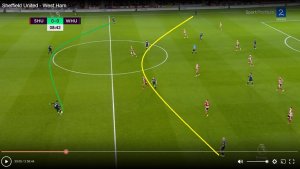
West Ham was another example of teams trying to stop our overloads down the wings. Both Klopp and Guardiola commented on the importance of getting that right recently. Over the past few seasons loads of teams have changed their formation on the day when they play us. West Ham lined up in a 3-4-3 formation, as shown below. Note how wide their wing backs are, trying to occupy our wing backs and preventing them from joining in with our midfield when pressing.
When we were in possession they tried to prevent space down each side. Two sets of four players (highlighted below) seemed to be instructed to stop our overloads:
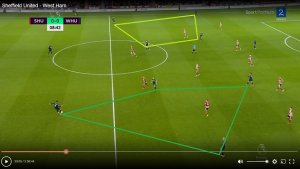
An example down their left, Cresswell (LCB), Masuako (LWB), Price (LCM) and Lanzini (L10) making it hard to get our usual neat passing going. With Cresswell and Masuako both starting they had two players who both are experienced as left full backs.
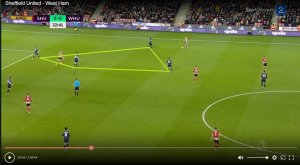
On the other side Balbuena (RCB), Zabaleta (RWB), Noble (RCM) and Anderson (R10), and on this occasion even Haller is down there. Zabaleta is usually an orthodox right back and it looks a defensive move when he's played at wing back.
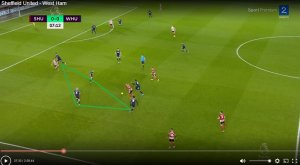
I think it worked pretty well for them in the first half. We had less of the neat combination play down the sides than normal, and Basham and O'Connell couldn't find the opportunities to join up with our attacks. Our pressing play suffered as we were more pegged back than usual and this affected our attacking play as well. What we created was mostly from set pieces.
We made adjustments in the second half, pressed higher, made more tackles and played with more enthusiasm and higher tempo. The game became more stretched and this suited us more than them. We also tried to switch play inside - naturally when they focus a lot on stopping us down the sides, they may be vulnerable in the central areas. Just before we scored Fleck had two central efforts from outside the box, and we had a great attack where Lundstram and Norwood won tackles and Norwood, McGoldrick and Fleck combined centrally before finding space on the left.
The game opened up even more after we scored.
So I think we'd better get used to teams finding ways to stop us, but there are ways to deal with that as well. What was said at half time worked and we showed we could adapt; later also helped by substitutions.
When we were in possession they tried to prevent space down each side. Two sets of four players (highlighted below) seemed to be instructed to stop our overloads:
An example down their left, Cresswell (LCB), Masuako (LWB), Price (LCM) and Lanzini (L10) making it hard to get our usual neat passing going. With Cresswell and Masuako both starting they had two players who both are experienced as left full backs.
On the other side Balbuena (RCB), Zabaleta (RWB), Noble (RCM) and Anderson (R10), and on this occasion even Haller is down there. Zabaleta is usually an orthodox right back and it looks a defensive move when he's played at wing back.
I think it worked pretty well for them in the first half. We had less of the neat combination play down the sides than normal, and Basham and O'Connell couldn't find the opportunities to join up with our attacks. Our pressing play suffered as we were more pegged back than usual and this affected our attacking play as well. What we created was mostly from set pieces.
We made adjustments in the second half, pressed higher, made more tackles and played with more enthusiasm and higher tempo. The game became more stretched and this suited us more than them. We also tried to switch play inside - naturally when they focus a lot on stopping us down the sides, they may be vulnerable in the central areas. Just before we scored Fleck had two central efforts from outside the box, and we had a great attack where Lundstram and Norwood won tackles and Norwood, McGoldrick and Fleck combined centrally before finding space on the left.
The game opened up even more after we scored.
So I think we'd better get used to teams finding ways to stop us, but there are ways to deal with that as well. What was said at half time worked and we showed we could adapt; later also helped by substitutions.


