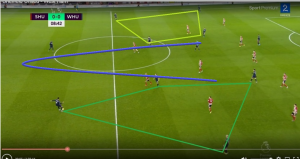
Teams trying to stop our overloads

All advertisments are hidden for logged in members, why not log in/register?

Great analysis. I often think, you just need one player to do something out of the ordinary to break a system like that. It's where "mavericks" and "wild cards" have their value. You might not want them in the team every week, but to have one on the bench that you can throw into the mix against sides like that who have set up very methodically is a real bonus.
A bit of a random thought - I wonder if Wilder signed Ravel partly in the hope that he could be the extravagantly skilled maverick to bring on in such circumstances. In the Cup matches, I have been disappointed that I don't recall him trying anything out of the ordinary.


West Ham was another example of teams trying to stop our overloads down the wings. Both Klopp and Guardiola commented on the importance of getting that right recently. Over the past few seasons loads of teams have changed their formation on the day when they play us. West Ham lined up in a 3-4-3 formation, as shown below. Note how wide their wing backs are, trying to occupy our wing backs and preventing them from joining in with our midfield when pressing.

View attachment 68478


When we were in possession they tried to prevent space down each side. Two sets of four players (highlighted below) seemed to be instructed to stop our overloads:

View attachment 68479

An example down their left, Cresswell (LCB), Masuako (LWB), Price (LCM) and Lanzini (L10) making it hard to get our usual neat passing going. With Cresswell and Masuako both starting they had two players who both are experienced as left full backs.

View attachment 68480

On the other side Balbuena (RCB), Zabaleta (RWB), Noble (RCM) and Anderson (R10), and on this occasion even Haller is down there. Zabaleta is usually an orthodox right back and it looks a defensive move when he's played at wing back.

View attachment 68483


I think it worked pretty well for them in the first half. We had less of the neat combination play down the sides than normal, and Basham and O'Connell couldn't find the opportunities to join up with our attacks. Our pressing play suffered as we were more pegged back than usual and this affected our attacking play as well. What we created was mostly from set pieces.

We made adjustments in the second half, pressed higher, made more tackles and played with more enthusiasm and higher tempo. The game became more stretched and this suited us more than them. We also tried to switch play inside - naturally when they focus a lot on stopping us down the sides, they may be vulnerable in the central areas. Just before we scored Fleck had two central efforts from outside the box, and we had a great attack where Lundstram and Norwood won tackles and Norwood, McGoldrick and Fleck combined centrally before finding space on the left.

The game opened up even more after we scored.

So I think we'd better get used to teams finding ways to stop us, but there are ways to deal with that as well. What was said at half time worked and we showed we could adapt; later also helped by substitutions.

Great post Bergen it was only a matter of time before teams tried this kind of method to stop us.This opens up a new area for us to go down the centre switching the ball very quickly,its eleven v eleven so spaces will open up. We tend to work harder than the opposition ( Liverpool excluded) so we need to press home that advantage just that bit more quality needed CWAK will be working on it.
 
Got some stick for suggesting other teams are starting to suss us out and counter how we play.

I think this is where Ravel Morrison's role could work really well next season when we inevitably start to look at different systems - not saying he's automatic bit he could certainly be a plan B for us when other teams block our wide areas/play.
 
That's why out of possession our wing backs were far too deep and should have pushed those opposition wing backs towards their own goal. Then see the space available for Fleck and Lunny if we'd turned over possession. West Ham are no Liverpool, we should not have been so afraid to press and I think that's what CW was alluding to in his post match interviews.
 
‘even when we weren't under pressure we seemed nervy and misplaced passes’

Could that be because once you press and pressure players they’re expecting it and try to do everything quickly, which leads to more errors?
I also commented they seemed very nervous during the first half. It could be because they were being pressed, but at the time I wondered if it was because they had lost the previous two and felt the pressure of this being one they ought to win.
 
I also commented they seemed very nervous during the first half. It could be because they were being pressed, but at the time I wondered if it was because they had lost the previous two and felt the pressure of this being one they ought to win.

Quite possibly, yes and maybe Watford was weighing on their minds too.
I was a bit frustrated at how we kept leathering it up front but having seen Bournemouth lose by fannying around in front of their goal it reminded me why we were doing it and why Wilder is the manager, not me.
 
Super analysis,

What’s impressive about our set up is the fact so many teams are changing the way they play in order to try and stop us playing. This gives us a huge advantage even before a ball has been kicked because were effectively playing our well drilled familiar system against an one-off unfamiliar opposition system, we’ve all seen teams rock up to the lane an literally not have clue what to do. it may not always work agianst the top 3 or 4 clubs in the division because they have enough world class talent to be flexible enough to adapt at short notice, although the rest of the division must have nightmares.
 
West Ham was another example of teams trying to stop our overloads down the wings. Both Klopp and Guardiola commented on the importance of getting that right recently. Over the past few seasons loads of teams have changed their formation on the day when they play us. West Ham lined up in a 3-4-3 formation, as shown below. Note how wide their wing backs are, trying to occupy our wing backs and preventing them from joining in with our midfield when pressing.

View attachment 68478


When we were in possession they tried to prevent space down each side. Two sets of four players (highlighted below) seemed to be instructed to stop our overloads:

View attachment 68479

An example down their left, Cresswell (LCB), Masuako (LWB), Price (LCM) and Lanzini (L10) making it hard to get our usual neat passing going. With Cresswell and Masuako both starting they had two players who both are experienced as left full backs.

View attachment 68480

On the other side Balbuena (RCB), Zabaleta (RWB), Noble (RCM) and Anderson (R10), and on this occasion even Haller is down there. Zabaleta is usually an orthodox right back and it looks a defensive move when he's played at wing back.

View attachment 68483


I think it worked pretty well for them in the first half. We had less of the neat combination play down the sides than normal, and Basham and O'Connell couldn't find the opportunities to join up with our attacks. Our pressing play suffered as we were more pegged back than usual and this affected our attacking play as well. What we created was mostly from set pieces.

We made adjustments in the second half, pressed higher, made more tackles and played with more enthusiasm and higher tempo. The game became more stretched and this suited us more than them. We also tried to switch play inside - naturally when they focus a lot on stopping us down the sides, they may be vulnerable in the central areas. Just before we scored Fleck had two central efforts from outside the box, and we had a great attack where Lundstram and Norwood won tackles and Norwood, McGoldrick and Fleck combined centrally before finding space on the left.

The game opened up even more after we scored.

So I think we'd better get used to teams finding ways to stop us, but there are ways to deal with that as well. What was said at half time worked and we showed we could adapt; later also helped by substitutions.
In the case of Man U, in the second half, they played three strikers very narrow, hence bringing our wing backs more infield, and then exploited the spaces out wide which is normally our domain.
 
A bit of a random thought - I wonder if Wilder signed Ravel partly in the hope that he could be the extravagantly skilled maverick to bring on in such circumstances. In the Cup matches, I have been disappointed that I don't recall him trying anything out of the ordinary.

I thought the same at the time Hodgy. We haven't seen much of it unfortunately. I mean, some of his tricks and flicks are sublime, but I've not seen him get hold of a game by the scruff of the neck and impose himself on it, which is what I was hoping to see. I thought he ran the game, as a young man, when he played for Man Utd in those FA Cup youth finals. I thought then that he would go on to be the next Gascoigne or something like that. Obviously he's had his issues and a lot of time has gone by since then, but, to me, he doesn't show any sign of being a dominant force on the park - and for all his tremendous skills that just isn't going to be enough I'm afraid.
 
I’m not sure you understood my point. I can’t really explain it any better as I don’t have the words, other than the ones I’ve used. It’s not really important anyway.
I think i kind of understood where you were going and perhaps I didn't respond to this aspect of what you were trying to say... you mean that even if they're not under direct pressure, but we're rattled (because a sustained period of pressure/ momentum) then we're more likely to make those basic errors or poor decisions...

Perhaps Egan is a good example, he had that horrific slip, then for the next 5-10 mins that would have been on his mind until he hg
 
I think i kind of understood where you were going and perhaps I didn't respond to this aspect of what you were trying to say... you mean that even if they're not under direct pressure, but we're rattled (because a sustained period of pressure/ momentum) then we're more likely to make those basic errors or poor decisions...

Perhaps Egan is a good example, he had that horrific slip, then for the next 5-10 mins that would have been on his mind until he hg
Yes, they kind of get into a mindset of having to move the ball on really quickly before they get closed down, even when they’re not actually being closed down.
But as Hamburger has said, they may also have had the pressure of being expected to get a home win after three slightly disappointing results and some potentially difficult fixtures coming up.
Relegation would be crap for us but crapper for a lot of them, they won’t all get new PL clubs and very few will get one as good to be a part of as we are.
 
Great analysis, what i would like to see is one of the midfielders driving through the middle (blue), or Egan bringing the ball out Maguire like.
Either they get a run towards the oppos back line, or more likely one of the 2 midfielders squeeze in to challenge, then leave the channel free to exploit
1578931817143.png
 
I'm just hoping teams don't cotton on to what is possibly the most effective attacking option against us - a long high punt down the middle from the goalie. Our centre-backs seem to have great difficulty judging when it's going to drop and have a tendency to get too far under it. Meanwhile (fortunately) many of the daft gits just seem to prefer trying to pass it out from the back and rarely get anywhere near the half-way line before losing possession. Watford's 1st goal against Bournemouth had me laughing my red, white and black Christmas socks off. Apologies for my assessment lacking the detailed analysis folks prefer these days, but sometimes it looks such a simple game (as Shanks once said).
 
Some good analysis on here.I guess the opposition can use our board as a shortcut on how we are playing.


Jack O'Connell has not been getting forward much in any match over the last few weeks,Bash has, but our leftside has been down to Fleck and Stevens.
Wether something has been said about having more cover at the back to stop balls over the top who knows
 
That's the case with any three at the back system. The natural counter historically is 4-3-3 as it allows the wide forwards to play inside your wingbacks and behind the wider centre backs. The positioning of our wide centre backs is different to the orthodox three at the back, however, so it can result in the wide forwards dropping too deep to mark them or the opposition getting swamped in the middle of the park as our three in the middle becomes a five.

I think it's worked to an extent when opposition teams have played wide men high up and hugging the touch line, partly what West Ham tried. Our centre halves don't want to drift that wide, meaning the wing backs are forced back and thus not being able to help as much with our pressing. We addressed this at half time.
 
Spot on, I was saying during the first half how we could have done with Duffy as the wildcard to create something in the central 'pockets' of space.
He would also have improved our throw ins which are a glaring weakness at this level (Duffy being the go-to player at receiving our throw ins over the last few years).
Hey Bergen Blade do you fancy doing some throw-in analysis of this for us? To me it seems an area we can improve markedly.

I'm not good on throw ins. I like the move we use, one touch back to the taker and quick cross, but maybe there should be more options. We never try the long throw, which I think is ok as we don't have the players to regularly win flick ons.
 
I think it's worked to an extent when opposition teams have played wide men high up and hugging the touch line, partly what West Ham tried. Our centre halves don't want to drift that wide, meaning the wing backs are forced back and thus not being able to help as much with our pressing. We addressed this at half time.

The change was interesting. We seemed to be trying to find McBurnie, more centrally and quicker to feet. Also Fleck seemed to push about 10 yards higher up the pitch (we wouldn't have scored that goal in the first half, he would've been too deep).
 
Bergen Blade Brilliant analysis and its interesting that you chose screen shots from the early part of the first half, 22 mins being the latest one.

I don't think the only reason for the poor first half was the way West Ham set up, even when we weren't under pressure we seemed nervy and misplaced passes, but its another example of teams trying to counter us by changing their own formation to match us. Apparently West Ham set up this way against Gillingham.

It didn't work though and Moyes didn't really have an answer when it failed as they weren't disciplined enough to keep the formation. I think it was later in the first half when it started to unravel, i seem to remember a big tackle from Lunny which got the crowd going and Wilder also alluded to this post match.

What i also love is that Wilder didn't change the approach throughout the game, as you said, second half before we scored we had two chances fall to fleck in very familiar territory coming to the box late after an attack down the right. Its worth noting that the strikers played a slightly different way against west ham, looking to support the wing backs more in the first half and often when the Wing backs had the ball in crossing positions either McBurnie or McGoldrick weren't in the box or we didn't have enough bodies in the box.

We also didn't make a change of personnel until 60 mins, which as after we scored and Mousset made yet another immediate impact but we then reverted to a more familiar set up with Mousse playing off McBurnie.

While I think it worked ok for West Ham first half it takes even more to do it for a full game. Moyes was probably going "this is going great lads, just continue", while I imagine Wilder and Knill told the players how we should tweak things. With that and a pep talk, us attacking the Kop, it was always going to be tougher for them second half if they didn't react to what we did.
 
Bergen Blade was there any sign of the players trying to resolve this on-field before half time?

You'd think the leaders would spot something and make adjustments accordingly, and not wait until half time for instructions.

Don't know, but personally I was a bit relieved we got to half time at 0-0 and felt we needed real input and motivation from the management.
 
I really noticed the 4 players on each side stopping the attacks down the flanks.

It was also noticeable immediately that Mousset came on that we caused problems with long balls down the middle as they weren’t as able to battle for second balls.

Right now it seems that as fast as teams adapt, we’re able to switch to another plan.

The other thing it made me think was that if we had a player in Lunny’s position who could beat a man and surge with it that it would really create problems for teams who set up like West Ham.

Yes. Sometimes I've wondered if it would be worth having Morrison on the bench, and not three strikers. While Besic did very well when he came on, I'm not sure he would have been ideal if the score had remained 0-0 and we were pushing for a goal.
 
A bit of a random thought - I wonder if Wilder signed Ravel partly in the hope that he could be the extravagantly skilled maverick to bring on in such circumstances. In the Cup matches, I have been disappointed that I don't recall him trying anything out of the ordinary.

Some glimpses:

 
Some glimpses:


I was really excited at the prospect of Ravel and i still hope that he comes through towards the end of the season. Perhaps he will after this next two games.

But that video doesn't show enough of what you'd want to see on the bench. You want a game changer.

Theres some nice touches there, he's comfortable in tight areas and under pressure, but some of his passes are speculative than incisive and defence splitting.

Given that we use Fleck and Lunny in roles where they get into the box late to open games up, where do you see Ravel being able to do that?

I actually thought we'd see Ravel playing more of a Duffy role, which has now gone and been replaced with the Fleck/ Lunny and McGoldrick roles taking on the Duffy responsibilities between them.

Could Ravel play the McGoldrick role when we need more creativity than McBurnie?
 
I was really excited at the prospect of Ravel and i still hope that he comes through towards the end of the season. Perhaps he will after this next two games.

But that video doesn't show enough of what you'd want to see on the bench. You want a game changer.

Theres some nice touches there, he's comfortable in tight areas and under pressure, but some of his passes are speculative than incisive and defence splitting.

Given that we use Fleck and Lunny in roles where they get into the box late to open games up, where do you see Ravel being able to do that?

I actually thought we'd see Ravel playing more of a Duffy role, which has now gone and been replaced with the Fleck/ Lunny and McGoldrick roles taking on the Duffy responsibilities between them.

Could Ravel play the McGoldrick role when we need more creativity than McBurnie?

Only glimpses and I also hoped he'd show more. But there's a goal in there and some clever passes in congested areas? I think he'd be worth a try in games where we're chasing the game and struggling to create with midfielders running into a defensive wall. There could be more games like that towards the end of the season.

Maybe he could do the McGoldrick role in some games, but if we're chasing games I think Wilder would like to have two strikers. Maybe worth a try if we're defending a lead, McGoldrick is tired and we want someone to link play, hold on to the ball and maybe thread a ball through to Mousset/McBurnie?
 
Yeah, great analysis. My brother and I noticed they were playing to stop us in the first half. I think Leeds did the same last year at BL. It's good that Wilder and Knilly were able to adjust slightly second half and get us the win.
 
Our Blades, discussed internationally, as tend setters, for others to learn from.

Our Blades.

Wow. This is the greatest era to be a Blade.
 
If they try to stop our overloads, lets just overload even more. Time for the overlapping goalkeeper. Ergo, goalie wag.
 

All advertisments are hidden for logged in members, why not log in/register?

All advertisments are hidden for logged in members, why not log in/register?

Back
Top Bottom