
Bergen Blade
Well-Known Member
Using his regular 4-4-2 formation, Adkins played Coutts and Flynn in the wide positions against Doncaster. But how wide are they? Quite often - not very.
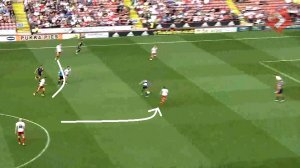
Let's look at one passage of play:
It seems like we're going nowhere, Basham even points to Edgar and wants Baxter to pass it back to him:
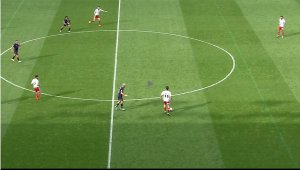
But Baxter has the composure to hold on to the ball for a second. With the skill to sidestep the Doncaster midfielder and the accuracy of his pass, Baxter finds Coutts in some space.
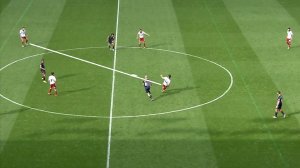
Coutts has time and space to pick a pass. His through ball finds Sammon who very nearly scores.
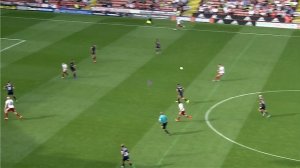
This is quite different to traditional wing play, where wingers stayed wide, looked to get on the ball, take on their full back and put crosses into the box.
The shape of our midfield in this situation is more like a box with all four very central. On the attack - our formation has been described as 4-2-2-2:
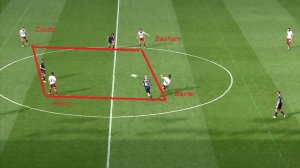
But even this isn't quite accurate, as it doesn't include the movement of the full backs, very often more advanced than even the two "wide", or attacking midfielders.
(This is why formations should primarily describe how a team lines up defensively when the opposition have the ball. On the attack it gets too complicated.)
The above situation certainly got too complicated for Doncaster. They couldn't figure out who was supposed to deal with Coutts.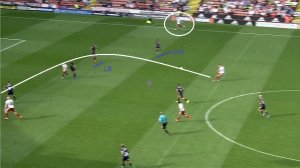
Coutts position was right midfield. Normally the opposition left back deals with him. But when Coutts is so deep, so central, it makes less sense for him to break out of the defensive line and push up to challenge him.
So what about the opposition left midfielder? Left midfielders traditionally keep an eye on the opposition right back. And as can be seen, Alcock (white circle) is bombing forward on that side, forcing said midfielder to stay wide and track him. Even though Alcock doesn't get the ball, his run may have been vital in letting Coutts get time and space on the ball.
Summary: Our "wingers" will probably be staying less wide than previously. Our full backs may be the ones who provide real width.
Let's look at one passage of play:
It seems like we're going nowhere, Basham even points to Edgar and wants Baxter to pass it back to him:
But Baxter has the composure to hold on to the ball for a second. With the skill to sidestep the Doncaster midfielder and the accuracy of his pass, Baxter finds Coutts in some space.
Coutts has time and space to pick a pass. His through ball finds Sammon who very nearly scores.
This is quite different to traditional wing play, where wingers stayed wide, looked to get on the ball, take on their full back and put crosses into the box.
The shape of our midfield in this situation is more like a box with all four very central. On the attack - our formation has been described as 4-2-2-2:
But even this isn't quite accurate, as it doesn't include the movement of the full backs, very often more advanced than even the two "wide", or attacking midfielders.
(This is why formations should primarily describe how a team lines up defensively when the opposition have the ball. On the attack it gets too complicated.)
The above situation certainly got too complicated for Doncaster. They couldn't figure out who was supposed to deal with Coutts.
Coutts position was right midfield. Normally the opposition left back deals with him. But when Coutts is so deep, so central, it makes less sense for him to break out of the defensive line and push up to challenge him.
So what about the opposition left midfielder? Left midfielders traditionally keep an eye on the opposition right back. And as can be seen, Alcock (white circle) is bombing forward on that side, forcing said midfielder to stay wide and track him. Even though Alcock doesn't get the ball, his run may have been vital in letting Coutts get time and space on the ball.
Summary: Our "wingers" will probably be staying less wide than previously. Our full backs may be the ones who provide real width.