
Silent Blade
Well-Known Member
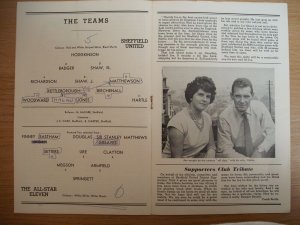
YesDid Graham Shaw & Stanley Matthews both play in the Joe Shaw testimonial?

Follow along with the video below to see how to install our site as a web app on your home screen.
Note: This feature may not be available in some browsers.
All advertisments are hidden for logged in members, why not log in/register?
YesDid Graham Shaw & Stanley Matthews both play in the Joe Shaw testimonial?

Brilliant read about one of my first Blades heroes - thanks for that!
I could never understand why Billy Wright won over 100 caps for England and not one for Joe Shaw; I know I was biased but to me Joe was a better and more cultured footballer.
I always felt Hodgy was superior to Hopkinson too so maybe I was a tad blinkered. I have to concede I thought Ron Springett was brilliant, so maybe not so biased after all?
How does a 41 year old winger play for England? By the time he was 50 and up against Graham Shaw he was probably a bit past his prime, and I remember thinking Graham Shaw went easy on him - or was it that he didn't really feel confident enough to put a tackle in?
Not Ron Harris in the Chelsea v Stoke match in April 1963. He took his legs clean out from underneath him. At half time few of the older players laid at Ron. "I helped him get up, didnt I" was Ron's only defence. "But you hurt him Ronnie, he was rolling around clutching his shins". "Na that wasnt me, That's his arthritis!"Matthews was still one of England’s best players in the mid 1950s. He focussed a lot more on his fitness than most other players of his era which made a big difference. I was told by a few people who saw him play towards the end in the early 1960s that by that time some full backs were going easy on him.
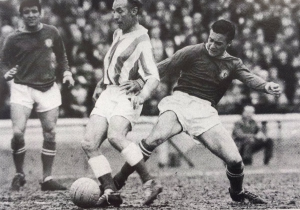


Billy Hodgson - another one of my all-time Blades heroes. He was our most tenacious player, and no-one came close to his graft until the bearded wolfman dropped into town. Every successful team needs a Billy Hodgson. I suppose Nick Montgomery's graft was somewhere along the same road but not in the same league I think.Very much an unsung hero .
Even in his late 40's old Stan had a sharp turn of speed that gave him an edge. He'd stand in front of the defender, passing the ball from left to right in the wink of an eye and the defender would be reluctant to commit. Back then full-backs were more inclined to put a foot in, but Stan was so quick-footed they'd be wary of that and try to anticipate when he'd make his move, but from a standing start he had always been Porche-like off the mark and if they weren't sharp-witted enough and quick enough to react, they'd end up on their arses.Matthews was still one of England’s best players in the mid 1950s. He focussed a lot more on his fitness than most other players of his era which made a big difference. I was told by a few people who saw him play towards the end in the early 1960s that by that time some full backs were going easy on him.
My dad recalled to me that Stan Matthews sold a dummy to Albert Cox, our full back, and Cox ended up clashing with a corner flag! Cox was raging and threw the corner flag in disgust!Even in his late 40's old Stan had a sharp turn of speed that gave him an edge. He'd stand in front of the defender, passing the ball from left to right in the wink of an eye and the defender would be reluctant to commit. Back then full-backs were more inclined to put a foot in, but Stan was so quick-footed they'd be wary of that and try to anticipate when he'd make his move, but from a standing start he had always been Porche-like off the mark and if they weren't sharp-witted enough and quick enough to react, they'd end up on their arses.


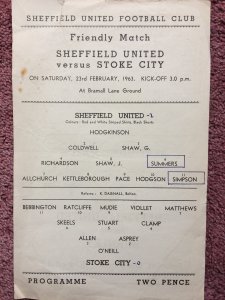
Looking through the programmes following the 2 games against Stoke in Sept 1963, it seems that he missed both through injury. The programme v Wednesday, 3 days after the home game, was written before the Stoke game, and says that it was uncertain whether Matthews would be able to play, and in the Liverpool programme, following the away match, it reports disappointment that Matthews was again unable to play. It doesn't sound like it is simply that he was being rested or dropped.Was he injured? Stoke got promotion in 1963 and maybe they thought they would use him sparingly for the 1963-64 season?

Kind words. In fact I remember him from my first match (Sept 1953), but can’t remember even going to the one in 1963. But I have enjoyed this whole thread, with another post to follow shortly. ThanksHodgy... I'm very honoured to have in some way provoked your memories of Stanley Matthews and the Blades . I'm sure you still have many things to tell us all.
Keep it coming and make sure you look after yourself during the next few weeks!
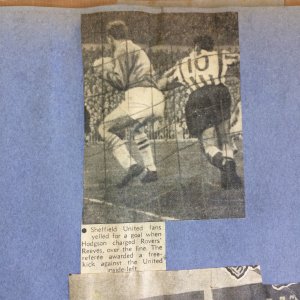
We have moved a good way from Colin Grainger, but the best threads on here usually end up in unexpected places. I found myself nodding in agreement as I read what you said about Hodgson, and would add one detail. Arguably his best performance for Utd was in the 3-0 Cup win at Spurs in 1958, when Joe Mercer gave him the job of following Danny Blanchflower (one of my favourite non-Blades) for the whole 90 minutes, and cut off the creative supply that Blanchflower normally provided. Hodgson stuck like glue to him for the whole game, and kept him out of a game which United won comfortably in a huge upset. It was a remarkably disciplined performance, and as Blend-it-like-Harris said, something that Montgomery could also do if asked. I attach a newspaper report from the old scrapbook, and I hope the tribute to Hodgson and Mercer is legible:One name on that team sheet is a player who has rarely been discussed on here and that is Billy Hodgson .
Those of my generation will remember him as a slightly built but tenacious midfield player , not lacking in skill and capable of scoring more than the odd goal .
However , he will be most remembered by his nickname 'The Mudlark ' which derived from the fact that for whatever reason , all of his best performances seemed to come about in shocking conditions . The muddier the pitch and the rainier the day saw Hodgson at his very best .
In one match I saw , possibly against Bolton , he gave a quite remarkable performance in the most appalling weather when he constantly won the ball then skipped past players leaving them flat on their arse , which after the fourth or fifth time of happening resulted in huge applause from all parts of the ground .
Very much an unsung hero .
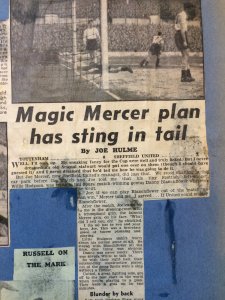
Glad you liked it. I hope the pic below gives the rest of the report clearly enough. I also attach the Heap cartoon (always loved those), and some more pics, including Hodgy wearing gloves, which didn't often happen. In defence of modern youth, you may have picked up that aged 10, I couldn't spell 'fourth'. I was hoping to find more comments on the Spurs match, but the next home game was called off because of the Munich disaster, and so the next home programme was the 5th round v WBA, which barely mentions the Spurs game.Fascinating stuff Hodgy and many thanks .
I well remember the elation when hearing that we had beaten that great Spurs team so comprehensively but was never aware of Mercer's tactical plan until now .
Have you got the rest of the report and if so , can we have it please ?
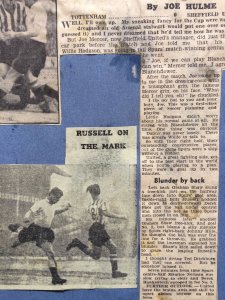
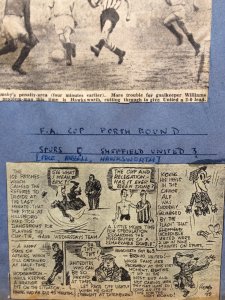
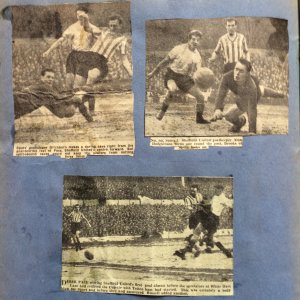
Glad you liked it. I hope the pic below gives the rest of the report clearly enough. I also attach the Heap cartoon (always loved those), and some more pics, including Hodgy wearing gloves, which didn't often happen. In defence of modern youth, you may have picked up that aged 10, I couldn't spell 'fourth'. I was hoping to find more comments on the Spurs match, but the next home game was called off because of the Munich disaster, and so the next home programme was the 5th round v WBA, which barely mentions the Spurs game.
View attachment 74497View attachment 74498View attachment 74499

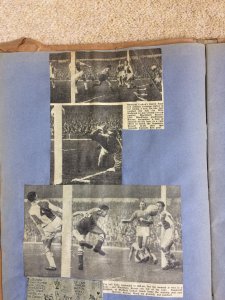
As a bonus, some pics from a less celebrated giant-killing, the 2-1 win v Blackburn in 1961. The iconic picture in my mind of Hodgson is the bottom one on the first pic, nipping into space between several defenders to use his ‘height’ to score a header. The top pic also shows the same goal, with Pace on his backside, having typically won his header to play the ball into the danger zone. The other incident on the next page is a disallowed goal - Hodgson was not afraid to mix it, but the photo suggests the ref got it right, as he elbowed the keeper in the back.
My grandad was an ARP warden in ShiregreenThere is no polite way to ask this, I guess, but I would love to see a picture of your rattle to compare it with mine (see my avatar picture). Mine was my Grandad’s, as he was an ARP warden, and they were to used to warn of gas attacks, I think. Me and my brother persuaded him to give it to us, and we painted it as shown in the pic. It makes a hell of a racket.
Do you know if it’s right that the rattles were used to warn of gas attacks?My grandad was an ARP warden in Shiregreen
Not sure. Will ask my mum.Do you know if it’s right that the rattles were used to warn of gas attacks?
Finally found the programme. I hope you can read the Joe Shaw description- ‘Not a big ‘un, but one of the best pivots around’. How many times did we read that in away programmes and national press match reports?Fascinating stuff Hodgy and many thanks .
I well remember the elation when hearing that we had beaten that great Spurs team so comprehensively but was never aware of Mercer's tactical plan until now .
Have you got the rest of the report and if so , can we have it please ?
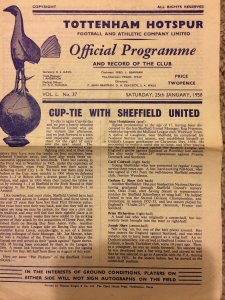
Finally found the programme. I hope you can read the Joe Shaw description- ‘Not a big ‘un, but one of the best pivots around’. How many times did we read that in away programmes and national press match reports?
View attachment 74850
I always just accepted 'pivot' as the word for a good centre-half who played like Joe Shaw (for those who never saw him, think John Stones, but smaller, able to defend, not likely to make howlers, and good at marking). I assume that it came from an earlier era when the centre-half was the midfielder who controlled play, and as the centre-half gradually became a defender, the word stuck, and was very appropriate for describing a footballing centre-half like Joe Shaw.Thanks once again .
'Pivot' eh ? I'd completely forgotten about the use of that term for a centre half - probably not heard it for 60 years or more .
I always just accepted 'pivot' as the word for a good centre-half who played like Joe Shaw (for those who never saw him, think John Stones, but smaller, able to defend, not likely to make howlers, and good at marking). I assume that it came from an earlier era when the centre-half was the midfielder who controlled play, and as the centre-half gradually became a defender, the word stuck, and was very appropriate for describing a footballing centre-half like Joe Shaw.


This is just a fabulous, fabulous read!

How it feels when you score two goals against Brazil on your England debut
Colin Grainger was trembling with nerves on his way to Wembley. By the time he left the pitch, he felt like he belongedBy Colin Grainger with Hyder Jawad, via The Blizzardwww.theguardian.com
"I joined up with the England squad at Lancaster Gate on Monday 4 May 1956, five days before the match, and I felt as small and as insignificant as I had when I turned up for my first day as a professional with Sheffield United. "
Just finished reading Colin Grainger's autobiography & what an incredible read & in fact it is one of the best sporting biographies I have ever read.
It is a must for all United supporters of that era & it is a clear insight of what life was like in the period after the war.


 www.bbc.co.uk

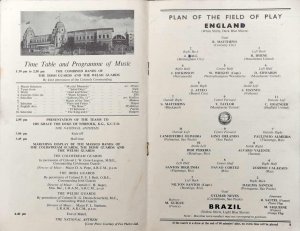
A very moving story for these times. I was impressed with Harry Kane taking the trouble to contact him, and to highlight the link between them.Harry Kane calls ex-player Colin Grainger as he is in isolation alone
The England captain and Colin Grainger, aged 86, both scored on their debuts for the Three Lions.


All advertisments are hidden for logged in members, why not log in/register?
