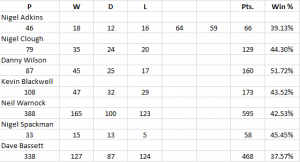
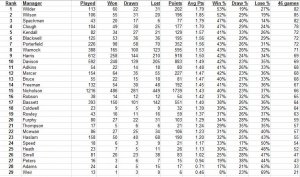
An interesting problem but one that's easily overcome .
The variance and the closely-related
standard deviation are measures of how spread out a distribution is. In other words, they are measures of variability.
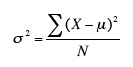
The variance can be computed as the average squared deviation of each number from its mean. For example, for the numbers 1, 2, and 3, the mean is 2 and the variance is:
.
In other words a comparison between Bassett and Wilson whilst not apples and pears is problematic. But .....
where μ is the mean and N is the number of wins for them both you can already see a variant pattern emerging .
When this variance is computed in a sample the statistic finally shows what we were all thinking .
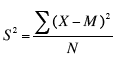
In other words N (where M is the mean of the sample) can be used. S² is a biased estimate of σ², however. By far the most common formula for computing variance in a sample is:
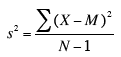
which gives an unbiased estimate of σ². Since samples are usually used to estimate parameters, s² is the most commonly used measure of variance. Calculating the variance is an important part of many statistical applications and analyses. It is the first step in calculating the standard deviation.
When you follow this simple to follow formulaic expression you can then very easily see that regardless of the statistical analysis performed DB will always be better than Wilson cos Wilson had a pig tattoo on his cock .