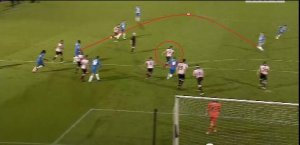
As I said at the time on Twitter, I think he was caught out by the flick on, he really should have followed his man though.
David Weir seemingly thought we could score all our goals by building slowly from the back. However some (slightly old) stats showed that it took on average
234 attacks to score a goal when you started building from the back. When the ball was won in the opposition's half it took
34 attacks to score a goal.
For Colchester's first goal we were on the attack, had plenty of players forward and McGinn on the ball trying to pass a through ball. It was intercepted, and from then on we didn't take any of several attempts to stop Colchester before the ball was in the net:
- Straight away, McGinn looks likely to win the ball back, but the Colchester player plays the ball through his legs, and they bomb forward
- Seconds later they are getting near our box, Doyle gets a foot in, but fails to clear the danger
- Coady (off camera) seems to lose a tackle and the ball goes out wide to their left footer who crosses
- Maguire gets his head to it, but can only flick it on
- To Bonne, who Hill has left unmarked
So, in one attack we have five players with a chance to stop the attack, though only the last one, Hill, makes a huge error.
A personal theory:
I think when defenders see that teammates have a chance to clear, they are often likely to lose concentration for a split second. This is one of the reasons it's so effective to try and score goals immediately after winning possession high up the pitch. If this happens a couple of times in a row, the chance is even bigger. It makes defenders switch off, they become ball watching, get sucked into wrong positions and lose the players they should be marking. It's probably human nature, and exhaustion doesn't help.
Training ground advice
Get it hammered into all players, certainly defenders, how important it is to stay EXTRA focused in the key situations where the team has lost possession in our own half. If it happens more than once in a row, alarm bells should be ringing.